High-Risk Merchant Accounts & Payment Processing By Corepay

Custom, reliable, high-risk payment processing with Corepay. We specialize in fast approvals, chargeback prevention, and seamless payment processing to help you grow.

Get Your Free Quote Today

Looking for a reliable, long-term high-risk merchant account provider? You’re in the right place. Corepay specializes in high-risk credit card processing for merchants who’ve been turned away by traditional processors like Stripe, PayPal, and Square. We offer fast approvals, aggressive pricing, and industry-leading support for businesses operating in complex, high-risk verticals.

Whether you’re launching a new business or replacing a terminated MID, we make it easy to get approved and stay approved, with the tools, compliance support, and gateway technology needed to scale safely in 2025.

Getting Started:

  • High-risk merchant accounts are for businesses that are risky for traditional banks and processors
  • Corepay offers reliable merchant accounts for the US, UK, and EU, and we also boast extensive banking relationships, allowing us to offer the most competitive rates.
  • Corepay offers over two decades of high-risk payment processing experience with extremely competitive pricing
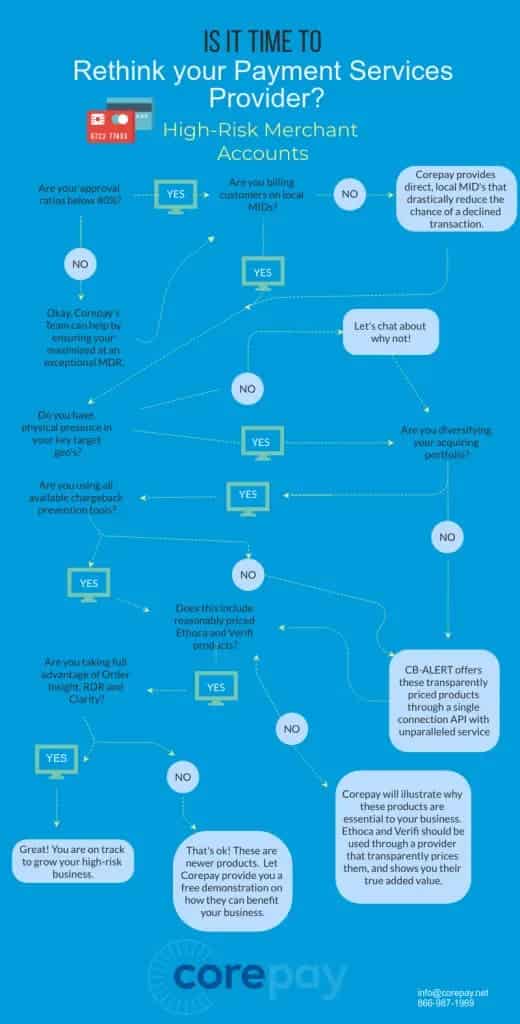
  • Maximizing approval rates is a must for high-risk merchants
  • With VIRP and Visa Acquiring Monitoring Program , obtaining a high-risk merchant account has never been as challenging as it is in 2025.
high risk merchant account descriptions

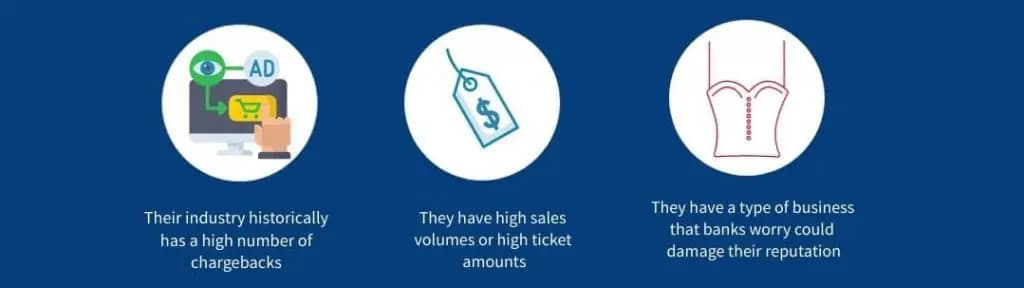
So, why are high risk merchant accounts considered risky? High risk merchant accounts are considered risky for the following reasons:

  • Chargebacks
  • Reputational issues
  • Legal regulations
  • The industry you operate within is risky for banks and processors

How To Apply

Corepay is dedicated to serving many different high risk industries, with most of our clients coming from:

At Corepay, we make the application process a breeze. Below are the following things you will need when applying:

  • Certificate of incorporation
  • A voided check, or other proof of bank accounts such as a signed bank letter or barring that, your bank’s routing number and your bank account number
  • Personal and business financial history
  • Organizational chart
  • Any licensing numbers and the name of the organization that granted the license
  • Six months of processing statements, if applicable
  • A compliant website, (stipulating terms and conditions, including refund policy)

Corepay offers the following for its high-risk businesses:

  • Fast approvals within 24-72 hours
  • No application, set up fees, or annual fees
  • Mitigate risk with our chargeback management services, CB-Alert
  • Order Insight by Verifi, 3-D Secure2.1
  • Traditional chargeback alerts
  • Low-risk rates, as low as $99 per month and $.05 per transaction
  • Maximize approval ratios based on your target customer base
  • Most competitive rates on the market for high-risk merchants
  • In-house payment gateway – Netvalve

Underwriting

Processors like ourselves prioritize upfront underwriting, offering transparency and stability from the start. This approach:
  • Flags potential risks before account approval.
  • Customizes solutions like reserves and fraud tools to fit your business.
  • Prevents sudden disruptions, ensuring your business runs smoothly.

In contrast, mainstream providers like PayPal or Square skip detailed underwriting, approving accounts quickly but often freezing funds or terminating accounts later if flagged as high-risk. This can cause major financial and operational headaches when your merchant account gets terminated.

With Corepay, our proactive underwriting means no surprises—just fast approvals (24-72 hours) and tailored support for high-risk industries. 

What Are High-Risk Merchant Accounts?

A high-risk merchant account enables businesses classified as high risk to accept credit and debit card payments. They are difficult to obtain due to the risks banks and processors take with each account.

examples

Your business may need a high risk MID merchant account if any of the following are true:

  • Your bank thinks they’ll take a loss on your account due to your personal credit or your company’s financials. They don’t want to spend more time and money dealing with your account than they’re going to make.
  • You have gotten, or will get, a high number of chargebacks – You should try to avoid chargebacks, to begin with, but if you’re a low-risk merchant who suddenly gets a lot of chargebacks, you can get bumped to a high risk account.
  • Your industry regularly has a high number of chargebacks. For example, subscription services, especially those with free trials, get a lot of chargebacks. When a free-trial user forgets to cancel their membership before the trial ends and gets charged for the first month, they’ll often issue a chargeback rather than admit they were negligent.
  • Your business or industry has a reputation of being risky and could damage the bank’s reputation. Things like gambling, adult entertainment, or CBD all make banks a little nervous about how their customers will see them.
  • You sell “future deliverable” products. Hotel rooms, plane tickets, event tickets, and other reservation-based items.
  • Your product or service has a long chargeback liability period. For example, if you sell annual memberships, your customers can issue a chargeback up to six months after the end of the service date. You may charge them on January 1, 2025, for an annual membership, but they have until July 1, 2025, to issue the chargeback.
  • You have a poor past history with other merchant accounts in general. because you’ve been dropped, labeled high risk, or generally had problems with your processor.
  • You have been on the Terminated Merchant File (TMF) or Mastercard Alert to Control High risk Merchants (MATCH) list. If you previously owned a business that made one of these lists, your next business is considered high risk.

How Does Having A High-Risk Merchant Account Affect You?

Being labeled high risk doesn’t mean you can’t accept payments. It just means you have to meet certain requirements, and or pay extra in terms of fees in order to keep the processors and banks happy.

You may pay a higher percentage in processing fees. (Be sure to factor this into your ROI.) Or you may have to keep extra money in a reserve account in case of chargebacks.

A reserve account is a sub-account attached to your own merchant account where a portion of your credit card sales are kept in order to cover any chargebacks and credit card disputes you might be hit with.

For example, some industries are more prone to identity thieves using credit cards to make purchases, like e-commerce electronics sites or electronics retail stores, especially if they offer “buy online, pick up in-store” (BOPIS) options — they’re prone to return fraud.

Credit Needed For A High-Risk Merchant Account

On average, you will need over a 550 credit score to obtain a high risk merchant account. With this being said, you can still get approved should you have a cosigner that has better credit involved in your business.

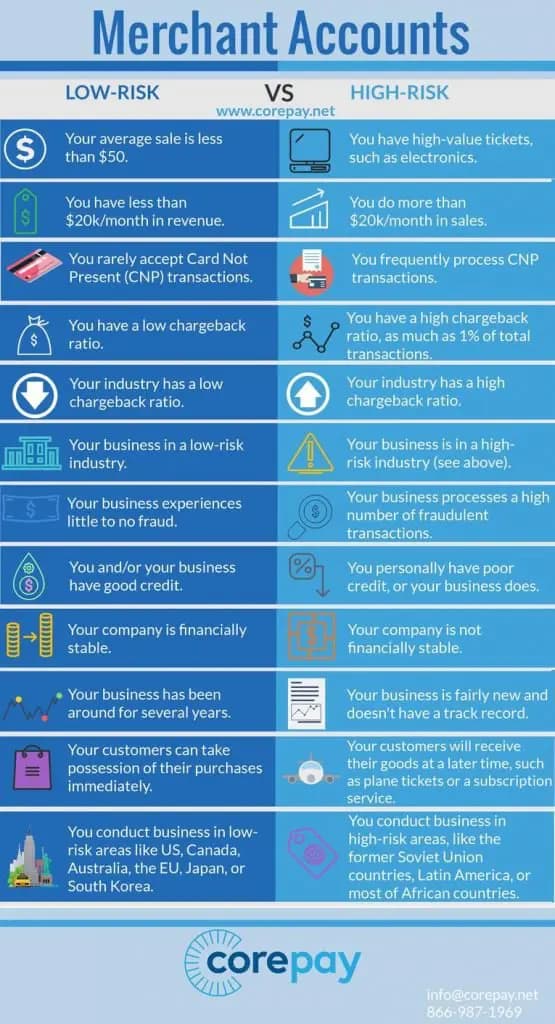
High Risk VS Low-Risk Merchant Accounts

Below you will find the differences between low-risk merchants and high risk merchants.

examples of low and high risk

Pros Of Going High-Risk

While it may cost more to have a high risk merchant account, there are some serious perks as well:

  • Companies that have financial difficulties or bad credit can still process credit cards and accept payments, which can help them recover and get back to being profitable.
  • Low-risk merchant processors won’t touch certain kinds of businesses at all.
  • There’s increased protection from fraud and chargebacks. Since high risk businesses are labeled as such because of the risk of chargebacks, their payment processor and issuing bank take extra precautions to protect themselves against chargebacks.
  • When hit with a lot of chargebacks, you’re less likely to lose your merchant account over it. (Still, try and avoid a lot of chargebacks.)
  • You can earn more money because high risk accounts may mean you are in an industry that involves high-profit margins.
  • A reserve account will protect you against surprise chargebacks. It may be a pain to have one, especially if you have to wait for as long as 180 days after account closure before you get your money, but at least the funds are there as the last line of defense, and the bank understands this.
  • You have global coverage, which means you can sell your products and services almost anywhere in the world. High risk payments service providers are used to a global outlook on payments and have the technology in place to help you grow.

Cons Of High Risk Merchant Accounts

  • You’ll pay more for merchant fees and services. You can expect to pay fees that are higher than traditional processing fees.
  • You have a rolling reserve account which can be as much as a cap of 50% of the approved monthly volume. Depending on your issuing bank and your payment processor, your rolling reserve can be held up to 180 days post merchant account closure.

Do Paypal Stripe And Square Deal With High-Risk Businesses?

No, they do not. If Paypal determines at any point that your account is high risk, such as CBD or Online Dating they can choose to terminate your account.

It may be easy to get one of these accounts up and running, but they also usually end quickly, with funds held for at least 180 days post account closure.

Corepay specifically works with high risk businesses and understands the risks associated with these industry types.

High-Risk Merchant Account Fees at a Glance

Fee TypeTypical for High-Risk MerchantsCorepay Advantage
Setup/Application FeesOften higher than low-risk merchantsNo setup or application fees
Early Termination FeeCharged upfront or upon cancellationWaived – we earn loyalty, not enforce it
Discount RatesMDR or Interchange Plus; some providers pad costsTransparent Interchange Plus pricing
Contract LengthOften 3+ years minimumFlexible terms
Authorization FeesCharged for every attempted transaction, even declinesStrategies to reduce decline costs
Settlement FeesCharged per approved transaction, sometimes bundled with auth feeOptimize fee structure for approvals
Chargeback FeesCharged per dispute regardless of outcomeChargeback prevention and recovery support
Non-Compliance/Penalty FeesFor PCI violations or non-EMV equipmentGuidance to avoid penalties and maintain compliance

How Do Chargebacks Work With High Risk Merchant Accounts?

detailed review of chargeback occurence

Chargebacks tend to happen for one of four reasons:

  • Technical Issues:  Non-sufficient funds, expired authorization
  • Quality Issues: Something was wrong with the product or service, or the customer didn’t receive it.
  • Clerical Issues: Duplicate billing, incorrect billing, or a refund was never issued
  • Fraud Issues: The customer did not authorize the purchase, or they were the victim of identity theft. Also called “malicious fraud.” The customer committed friendly fraud, and lied about quality issues or clerical issues. Says they didn’t receive a shipment or it was damaged.

When a chargeback happens, the customer calls the bank, gives a reason for wanting a refund, and the bank issues the refund.

The bank then contacts the merchant and gives them a very small window of opportunity to respond to the claim.

The merchant can either give a refund immediately or if they believe the chargeback was made in error or as a result of fraud, they can dispute the chargeback and show the bank that the purchase was correctly made and properly fulfilled.

Both Visa and MasterCard now have programs that help merchants fight friendly fraud and unknown errors.

A customer can call their bank, and order Insight by Verifi (a Visa company), or Mastercard’s Ethoca will provide transaction information in real-time.

The customer service representative can confirm a purchase, which may remind the customer that they did in fact buy the item in question.

Or they can require that the customer contact the merchant directly, which helps certain businesses, like restaurants that made a quality error on the delivery order.

Take the First Step Today

Partner with Corepay for a high-risk merchant account that prioritizes transparency, reliability, and growth. Apply now and secure your business's future.
Apply now

Powerful payment solutions that integrate with your existing platforms

Seamless Integrations

Corepay supports seamless integrations with top platforms like Shopify, Wix, WooCommerce, Salesforce, and more. From e-commerce to CRM tools, our payment solutions connect effortlessly to keep your business running smoothly. Discover how easy it is to integrate and optimize your payment processing.

  • Apple Pay
  • Authorize.Net
  • BigCommerce
  • Checkout Champ
  • FreedomPay
  • Google Pay
  • Magento
  • Microsoft 365
  • NetSuite
  • NetValve
  • NMI
  • Salesforce
  • Shopify
  • Wix
  • WooCommerce

Powering payments worldwide

Corepay proudly serves clients worldwide with specialized payment solutions tailored to meet the needs of diverse industries.

  • USA: Comprehensive payment solutions for high-risk industries.
  • Europe: Fully compliant with EU regulations for secure processing.
  • UK: Tailored support with fast approvals for emerging markets.
  • Canada: Flexible options for growing e-commerce businesses.
Photo of earth showing a connected world