Apple Pay vs Google Pay
Apple Pay vs Google Pay compared for merchants. Device support, tokenization, checkout flow, and which wallet performs better for specialty businesses.
Get approved for payment processing
Streamlined approvals and dedicated support from day one.
The Rise of Mobile Wallet Payments
Digital wallets such as Apple Pay and Google Pay are no longer fringe options for tech-savvy consumers. They have become essential payment methods across industries, from retail and hospitality to healthcare and subscription services. In 2025, more than 65% of U.S. adults use a digital wallet on a regular basis, with adoption especially strong among younger demographics who expect seamless checkout experiences.
Globally, mobile wallet transactions are projected to surpass $17 trillion by 2029, reflecting the shift toward faster, more secure, and more convenient payment technology.
For merchants, the takeaway is clear: offering Apple Pay and Google Pay is not only about meeting customer expectations, but also about driving higher conversions, reducing fraud exposure, and staying competitive in an increasingly mobile-first marketplace.
Apple Pay vs Google Pay: Market Share and Trends
Apple Pay continues to dominate the U.S. mobile wallet space with more than 65 million active users, representing nearly half of all digital wallet adoption. Its strength comes from deep integration into the Apple ecosystem, driving more than half of in-store tap-to-pay transactions nationwide.
Google Pay, now part of the broader Google Wallet platform, holds a significant share with over 30% of mobile wallet users. While its adoption in the U.S. trails Apple Pay, Google Pay has strong international reach, particularly in Europe and Asia, where Android devices lead the market.
On a global scale, Apple Pay is estimated to have processed over $8 trillion in transactions, while Google Pay follows with more than $5 trillion. For merchants, both payment methods are widely accepted: roughly 85-90% of U.S. retailers now take Apple Pay, with Google Pay supported at nearly 83% of locations worldwide.
Apple Pay vs Google Pay Comparison
| Feature | Apple Pay | Google Pay |
|---|---|---|
| Ecosystem | Works on iPhone, iPad, Mac, Apple Watch | Works on Android devices and Chrome browser |
| Market Share (U.S.) | ~65 million active users (~49% share) | ~35 million active users (~30% share) |
| Global Usage | Stronger in the U.S. and Western markets | Stronger adoption in Asia and Europe |
| Transaction Volume | Over $8 trillion globally | Over $5 trillion globally |
| Security | Device Account Number stored in Secure Element + cryptogram | Network DPAN tokenization + cryptogram |
| Authentication | Face ID, Touch ID, passcode | Fingerprint, PIN, or device lock |
| Acceptance | 85-90% of U.S. retailers | 83% of global retailers |
| Extra Features | Apple Card perks, Wallet integration (tickets, IDs) | Loyalty cards, P2P payments, transit passes |
Security Advantages of Apple Pay and Google Pay
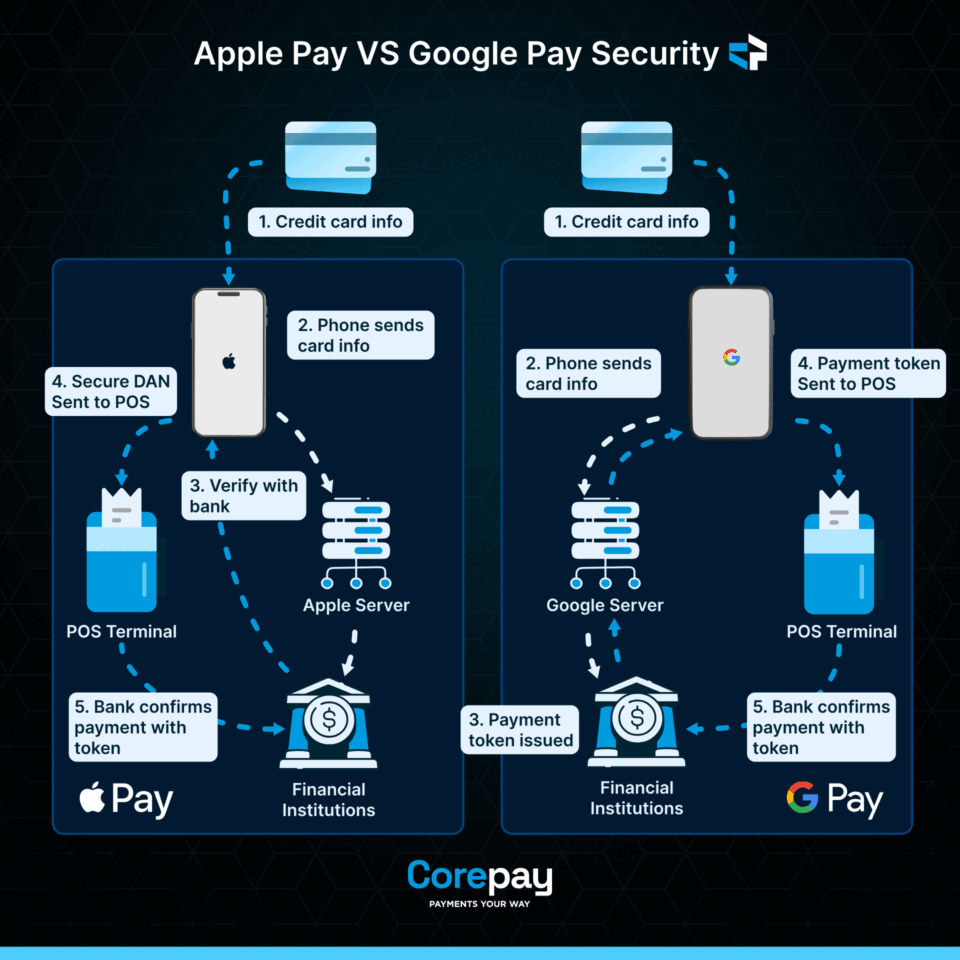
One of the most important reasons to integrate mobile wallets is the elevated level of payment security. Both Apple Pay and Google Pay rely on tokenization, which replaces the actual card number with a unique digital identifier.
This means sensitive data is never exposed to merchants or stored on checkout systems, reducing the risk of breaches.
With Apple Pay, each device is assigned a Device Account Number that is securely stored in the iPhone’s Secure Element. When a transaction occurs, the phone generates a one-time cryptogram that confirms authenticity without ever transmitting the real card number.
Google Pay uses a similar approach with virtual account numbers (DPANs). Tokens are often provisioned through Google’s infrastructure in cooperation with the card networks, and each transaction includes both the token and a dynamic code. This makes intercepted payment data useless to bad actors.
For merchants, this layered security reduces chargeback exposure and builds customer trust. Customers benefit from biometric authentication like Face ID, Touch ID, or fingerprint scanning, adding another level of protection at checkout.
Why Integration Matters for Merchants
Integrating Apple Pay and Google Pay is more than a convenience feature. For many businesses, it directly impacts revenue and customer experience. Studies show that customers are twice as likely to abandon their cart if their preferred mobile wallet is not available. By enabling these options, merchants reduce friction at checkout and encourage repeat business.
Digital wallets also accelerate payment speed. A single tap or face scan replaces the process of entering card details, speeding up both online and in-store checkouts. This is particularly valuable for high-volume businesses where every second matters.
Beyond customer experience, mobile wallets lower fraud risk. Since real card numbers are never transmitted or stored, merchants are less vulnerable to data breaches. Tokenization and biometric authentication also reduce instances of unauthorized transactions, which in turn helps limit costly chargebacks.
In short, Apple Pay and Google Pay integration allows businesses to meet customer demand, improve security, and streamline checkout flows-all of which translate to higher conversions and stronger trust.
Corepay’s Approach to Seamless Implementation
At Corepay, we make it simple for merchants to add Apple Pay and Google Pay to their payment stack. Our full-service platform is designed to support both standard and high-risk businesses, ensuring that integration is smooth, secure, and compliant.
Technical Integration Made Simple
Our team assists with every step of the setup process. For Apple Pay, this includes generating a merchant ID, installing payment certificates, and integrating Apple’s JavaScript API or mobile SDK. For Google Pay, we help merchants configure the API, define tokenization specifications, and properly load the Google Pay button across checkout flows.
Omnichannel Compatibility
Whether a business operates physical stores, eCommerce websites, or mobile applications, Corepay ensures that Apple Pay and Google Pay function seamlessly across all environments. This includes POS system compatibility, hosted checkout pages, and custom integrations.
Fraud Prevention and Compliance
Corepay leverages tokenization and dynamic cryptograms for each transaction to minimize fraud exposure. Our platform is built to meet PCI and EMV requirements, giving merchants the confidence that every mobile wallet transaction is both secure and compliant.
Conversion Optimization
A faster checkout leads to more completed sales. Merchants who implement Apple Pay and Google Pay through Corepay often see lower cart abandonment rates and improved customer satisfaction. By reducing friction, our merchants can create a modern payment experience that builds loyalty.
The Competitive Advantage for Merchants
Offering Apple Pay and Google Pay is no longer optional for businesses that want to stay competitive. Consumers expect the convenience of mobile wallets, and merchants who deliver it gain a measurable advantage. Faster checkouts, lower fraud rates, and higher conversion percentages all translate into stronger long-term revenue. For high-risk merchants, Corepay’s expertise in compliance and fraud mitigation ensures these benefits are realized without adding operational complexity.
Conclusion: Powering Mobile Wallet Payments with Corepay
Mobile wallets are shaping the future of payments. With Apple Pay leading adoption in the U.S. and Google Pay expanding globally, offering both options is critical for any merchant looking to grow in 2025 and beyond.
At Corepay, we provide the technical guidance, compliance support, and fraud prevention tools businesses need to integrate these solutions effectively.
By choosing Corepay, merchants not only enable Apple Pay and Google Pay, but also gain a payment partner focused on delivering secure, seamless, and scalable checkout experiences.